
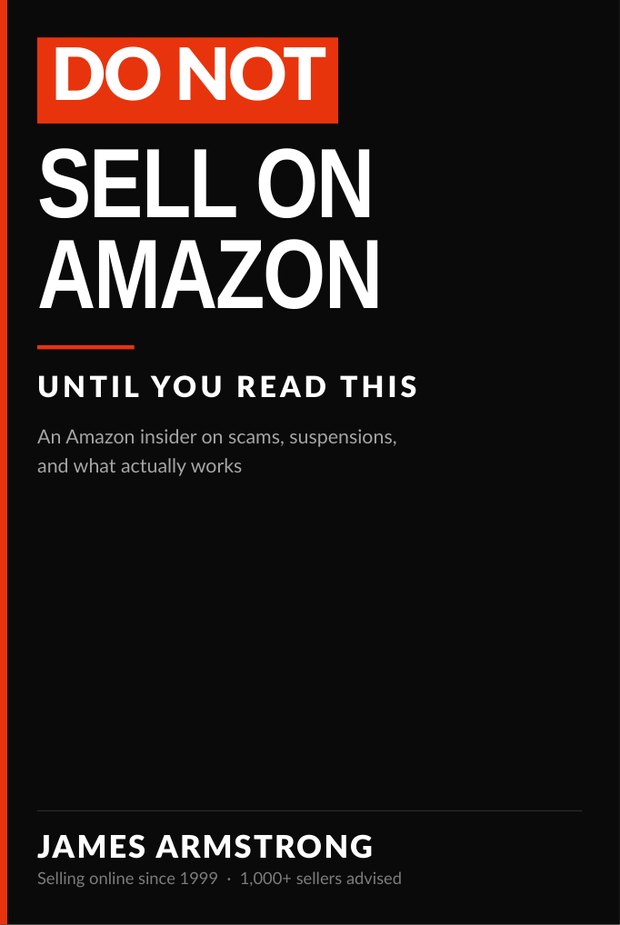
Most Amazon books tell you what you want to hear.
This one tells you why not to sell on Amazon — the scams, the fee math, the suspensions, and the offers that are too good to be true. Written by someone who ran more than 300 seller accounts and watched a great many of them lose money they could not afford to lose.
Buy the paperback on Amazon Read the Kindle editionOut now on Amazon in paperback and Kindle. See the seller tools · What is in the book
- 1,000+ sellers advised
- 300+ account-management clients
- Selling online since 1999
- 5.0 / 100% job success across 300+ freelance contracts
The advice industry preys on your optimism
Search “sell on Amazon” and you will find a thousand people promising passive income. Almost none of them will set out the real risks of selling on Amazon: what the regulators have already proven in court, and what happens the day your account is deactivated with your inventory inside a warehouse you cannot access.
So, is selling on Amazon still worth it in 2026? For some people it genuinely is, and this book is not an argument that nobody should ever do it. But new seller registrations on Amazon.com fell by 44 percent in 2025, and close to 60 percent of new listings now come from China-based sellers. Anyone telling you the opportunity has never been greater is not reading the same figures I am.
The other half of the picture is the advice industry itself. Amazon automation scams have drawn repeated federal enforcement, including a judgment of $21,765,902.65 against one set of operators and $15.7 million against another. Those are not warnings from a forum — they are court records, and I have collected them for you here.
Automation and “done-for-you store” operators have been ordered to surrender tens of millions of dollars and handed lifetime bans. The book names the cases and what the pitch sounded like beforehand.
Amazon is a living, breathing organism. What is permitted today can change tomorrow without notice, and what worked ten years ago will get you suspended now. Most books are frozen at their publication date.
Referral fees, FBA fees, storage, returns, advertising, and the money held back from your disbursements. Add them honestly and a great many products never had a margin to begin with.
“We have been working with James and Brand Marketing Concepts since 2014. His team is really dedicated and helps us every time we need it… I would highly recommend this service if you are an Amazon seller.” Esteban Araya, Director of Product Development, NetDyn
What is inside the book
Six parts, thirty chapters, and a forty-question test that tells you whether to proceed at all — including a glossary written for people who do not live in e-commerce.
How the marketplace actually works, the true fee stack, inventory and cash-flow traps, and why Amazon is its own world with its own rules.
The predators: automation schemes, mentorship pitches, merchant cash advances, GTIN and UPC resellers, brand-registry “tricks,” and review manipulation.
Account health, attacks from competitors, taxes, exits — and the turn: what the narrow, unglamorous path to a real business looks like.
The working documents behind the book
The book explains the decisions. These are the actual files used to make them — the tests, references, and templates from sixteen years of running other people’s accounts. No calls, no coaching, no upsells. You download them and they work without me.
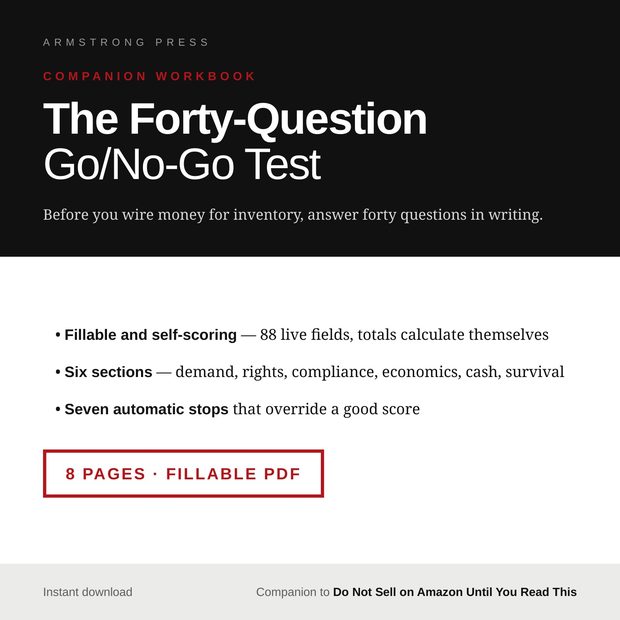
The Forty-Question Go/No-Go Test
Fillable, scored workbook. Answer forty questions about your product, capital, and risk tolerance and get a banded score that tells you to proceed, fix first, or walk away. $49
Get the workbook →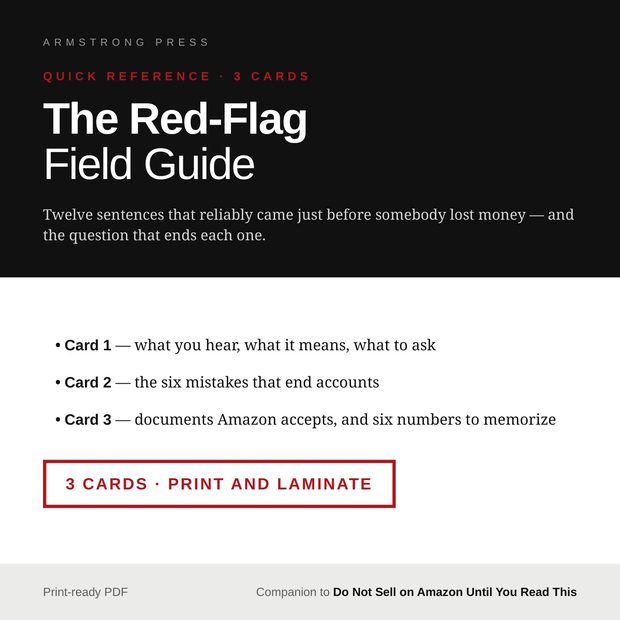
The Red-Flag Field Guide
Three-card quick reference for spotting a bad offer while you are still on the phone with it. Print it, keep it next to you. $29
Get the field guide →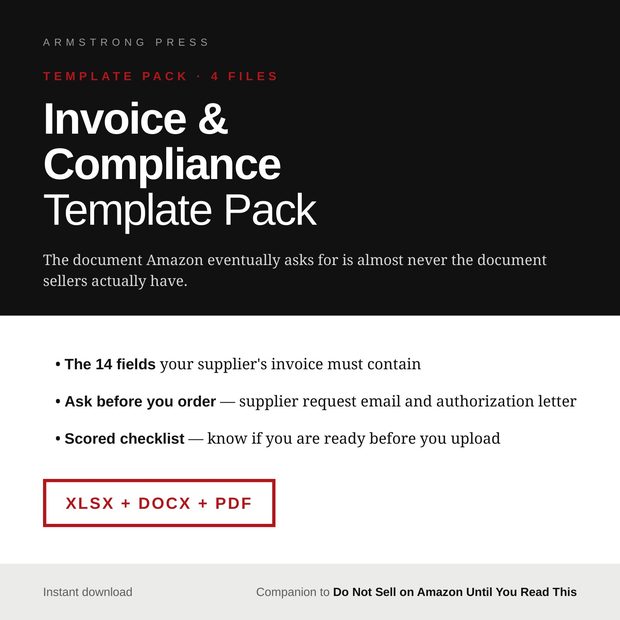
Invoice & Compliance Template Pack
The paperwork that gets ungating approvals accepted the first time — invoice formats, letters of authorization, and compliance checklists. $99
Get the templates →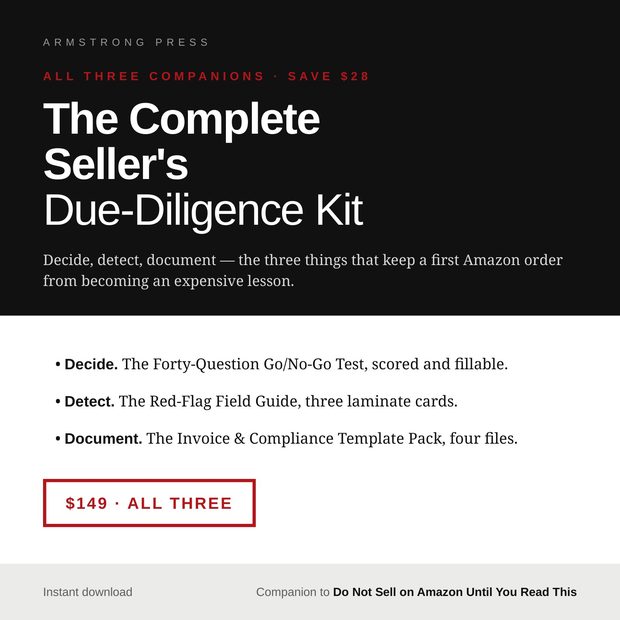
The Complete Due-Diligence Kit
All three together, which is how they were meant to be used: decide, verify, then document. $149
Get the full kit →The book lands shortly.
It costs a few dollars and may talk you out of spending thousands. Until then, the documents above are the same ones I used running client accounts.

Who is telling you this
I have been in business for myself since 1991 and selling online since 1999. I did not start with a course — I started with a failure. I had just closed my computer rental business and was selling the leftover inventory on eBay to keep the lights on, buying more at storage and business auctions.
In 2010 I founded Brand Marketing Concepts, LLC and moved to the other side of the table, running Amazon businesses for other people. Over sixteen years I worked with more than a thousand sellers, and more than three hundred were ongoing account-management clients whose businesses I ran day to day. I watched a great many succeed. I watched more lose money they could not afford to lose, usually for reasons that were visible from the beginning.
This book is the conversation I had over and over with people who called me one year too late.
Questions people ask before selling on Amazon
Is this just an anti-Amazon rant?
No. Amazon is a legitimate and enormous channel, and plenty of people make a real living on it. The argument is that the decision deserves honest numbers and a clear view of the risks before you commit capital — and that most of the available advice is selling you something.
I already sell on Amazon. Is it still useful?
The chapters on account health, competitor attacks, disbursement holds, merchant cash advances, and exits are written for people already trading. Existing sellers usually find the account-health and attack material the most immediately useful.
Do I need the book to use the workbook and templates?
No. They stand alone. The book explains the reasoning behind the questions, so most people find the two work better together, but neither requires the other.
Do you take consulting clients?
On a selective, ad hoc basis. There is no coaching package to buy and no retainer program — and I interview a prospective client before taking the work on, because I only take clients I can genuinely work well with. I am also not the right fit for a small seller on a tight budget, and I would rather say so plainly than take the money: that seller is exactly who this book and the working documents were written for, and they will do more for you than an hour of my time. If you are past that point and want to talk, start on the contact page.
What format are the downloads?
Print-ready and fillable PDFs, plus editable template files in the compliance pack. They are delivered immediately after checkout through Payhip.
Before you spend a dollar, read these two
Both are free, both are on this site, and between them they cover the vocabulary and the traps.
Amazon seller scams to watch out for
The automation pitch, the $35,000 seminar funnel, merchant cash advances, competitor attacks and phishing — each with the FTC or state case record behind it.
Amazon seller terms glossary
Every term you will meet in Seller Central or in a sales pitch, defined in plain English — including the words that exist to obscure something.
Decide before you spend.
Run the forty-question test before you commit capital. If it changes your mind, it just saved you a great deal of money. If it does not, you will go in knowing exactly what you are walking into.
Get the book on Amazon Start with the Go/No-Go Test Browse all the toolsThe companion volume
That is the warning. If you have already decided to sell, the second book is the procedure — thirty-four short chapters in the order the work actually happens.